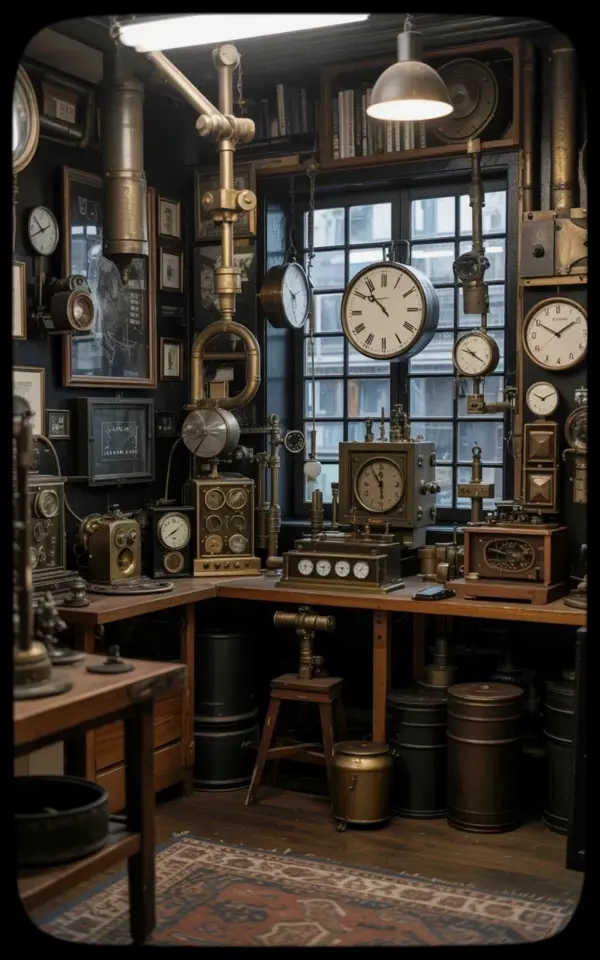
One round face with Roman numerals is watching you from the center of a dark wall. It’s not alone, but it’s definitely in charge. If you want a steampunk workshop decor that feels collected over decades instead of bought in an afternoon, you need a focal point that holds its own against pipes, brass, and scattered tools. The real room that inspired this post has it. The giant clock sets the rhythm, and every pressure gauge and exposed pipe in the room is just a supporting player. The effect is honest, heavy, and somehow cozy.
This is not the time for pristine museum pieces. This is the time for layers, for things with oxidation on them, for a wall that looks like it’s been busy for a hundred years. The best part? You probably already own half of what it takes to build this look. It’s just a matter of putting it together without overthinking it. We’re going to walk through exactly how that works, using the details from that cluttered, glowing workshop as our map.
## Build the Room Around a Statement Clock With Roman Numerals
The center wall in the photo holds a large round analog clock, the kind with a white face and bold black numeral marks that you can read from across a noisy room. That is your anchor. Nothing in a workshop interior should compete with it, so let the rest of the décor arrange itself in its orbit. The clock doesn’t need to be expensive or even working perfectly, honestly. A reliable ticking mechanism helps, but the visual weight comes from the size and the classic face.
I once passed on a huge antique clock at a flea market because the movement was seized up. I still regret it. Let that be a lesson: a dead clock is still a sculpture.
Here’s the thing, the surrounding pieces in the actual room, the pipes, the gauges, the smaller clocks, all of them seem to lean in toward that big face on the wall. They create a conversation. If the big clock were removed, the rest would just look like spare machinery parts.
## Use Pressure Gauges and Small Clocks to Build a Layered Wall Collage
Don’t line things up in neat rows. That is the fastest way to kill the industrial decor vibe. In the reference room, smaller clocks and pressure gauges are clustered around the larger piece at slightly different heights. Some are flush to the wall, others stick out a few inches. That variation in depth is what makes the display feel dimensional, like it grew there naturally.
Start collecting odd gauges anywhere you can. Ebay, estate sales, and old machinery junk piles are all fair game.
– Grab a few painted ones with cracked faces for texture.
– Mix one or two polished brass pieces to catch the light.
– Add the weird ones with unusual measurement markings, they make great conversation starters.
– If a gauge is missing its glass or needle, hang it anyway. The frame alone looks good.
Screw them directly into the wall or mount them on small wooden blocks to create shadow. A little distance from the flat surface makes them read as artifacts rather than decorations. That is a subtle trick that changes the whole feel of the space.
## Let Exposed Pipes and Dark Walls Set the Industrial Decor Tone
You can’t have a steampunk room without acknowledging the plumbing. The wall in the photo has exposed metal framework and piping that runs along the edges, framing the display. No drywall covering it, no apologies. If you don’t have real pipes in your space, fake it with conduit or metal tubing. You can buy flanges and fittings from a hardware store and mock up a convincing run of pipe that spans the length of the wall.
Dark paint on the walls does a lot of heavy lifting here. Deep charcoal, almost black, or a dirty bronze color will make any brass or copper you add really pop. The room uses dark walls to push everything else forward. The contrast is what creates that moody atmosphere.
Don’t be afraid of the darkness. It makes the warm hanging lights feel like actual light sources rather than just overhead fixtures. The grid-pattern window in the photo lets in natural light during the day, which softens the whole thing, but at night, the dark walls become the star.
## Install Warm Hanging Lights to Counter the Cold Metal
There is a moment in the room where the vintage rug softens all that metal and the hanging light fixtures throw a warm glow over every surface. That is the magic equation. The lamps aren’t harsh. They’re either Edison bulbs with that amber glow or fixtures with shades that send light down in a cone, not everywhere at once. It makes the room feel like a home, not a machine.
Use swag hooks to hang a few pendants over your workbench or a table. You don’t need to rewire anything major. A plug-in pendant with a long cord and a metal shade can do all the atmospheric work. Cluster the lights at different heights to add another layer to the space.
The warm light also picks up the patina on the gauges and the rusty spots on the pipes, turning what could look dirty into something beautiful. That is the whole trick. You’re not decorating with light. You’re spotlighting the history you’ve gathered.
## Layer a Vintage Rug Over the Floor for a Functional Contrast
A workshop floor is usually bare concrete, and that’s practical. But the photo shows a vintage patterned rug sitting there, right in the middle of all that machinery. It’s a genius move. The rug breaks up the hard industrial feel and absorbs some sound, which honestly makes the room feel more comfortable to stand in for long periods of time.
Choose a rug with a patterned design that has some faded red, gold, or deep green in it. Worn in spots is better than mint condition. A rug that looks like it has seen a few generations of foot traffic fits the vintage style you are going for. It also defines a seating area or a space in front of the workbench, giving your eye a place to rest.
The contrast between a delicate patterned rug and heavy iron pipes is what makes the room look intentionally designed rather than just distressed. It’s the same trick as wearing a crisp white shirt with a worn leather jacket. Opposites make each other look better.
## Arrange Your Finds With a Cluttered, Layered Display
The room is genuinely cluttered, but it’s not messy. There is a difference. The clusters of clocks and gauges are arranged with intent, even if it looks random. The best way to replicate this is to forget the rules of perfect spacing and just put things where they feel right. Group some items tightly on shelves, hang a few pieces on the wall, and prop a larger mechanical device on the floor.
Aim for a sense of abundance. Don’t just hang one clock and call it a day. You need an assembly. Hooks, gears, old tools, and metal signs all add to the texture. Put a couple of items in a spot where they catch the light and another pair in a darker corner for mystery.
If you see a blank space, don’t rush to fill it. Wait until you find the right piece. This look is built over years, not an afternoon.
You can also group things by tone. Put all the brass pieces near the window where the natural light will hit them, and keep the rusty iron stuff in the shadows. That arrangement makes the whole wall feel balanced without looking too arranged. This is not a dashboard where every dial has a purpose. Some of these are just there to look good, and that is perfectly fine.
## Don’t Overthink It, Just Start Clustering Your Finds
There is a freedom in this style that people miss. You don’t need to be an engineer or a collector of rare antiques to pull it off. The difference between a room that feels cool and a room that feels like a prop department is the willingness to commit to the clutter. Start with the big clock, and then let the smaller pieces accumulate around it.
If you’re reading this on your phone, stand up right now and look at the place you work. Notice the blank wall above the monitor or the corner that’s just collecting dust. Imagine a dark blue or charcoal paint color on it. Then picture a large clock there. Suddenly, everything else you see at flea markets has a purpose.
The vintage rug is a great starting point because it brings the whole look together and anchors the floor. The warm hanging lights make it livable. The exposed pipes make it honest.
So, which detail catches your eye first when you look at a room like that? Is it the big Roman numeral clock claiming the wall, or the small pressure gauge tucked into the corner? Comment below and share your take. Your perfect steampunk workshop is waiting. Go find your clock.
Leave a Comment