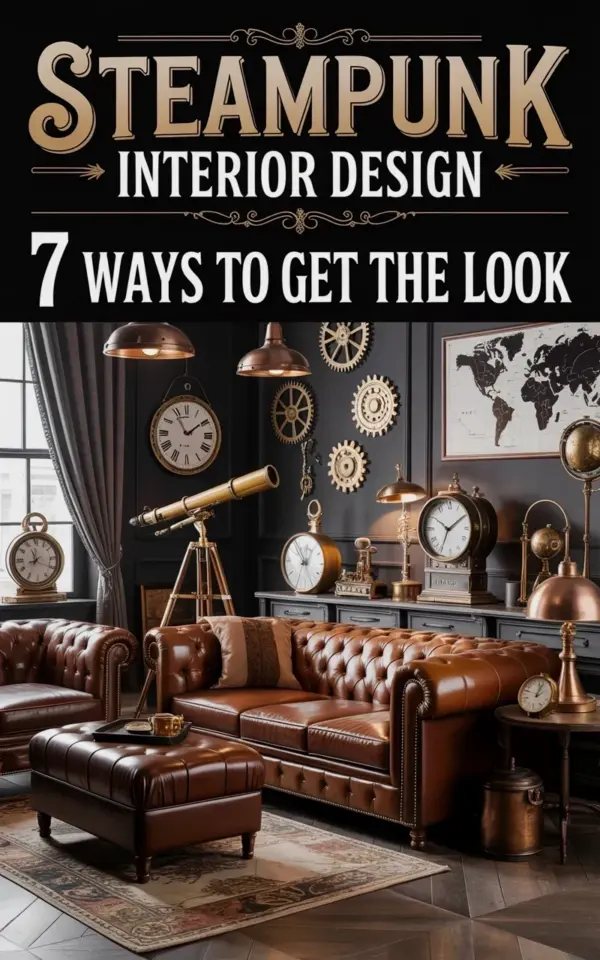
Steampunk interior design feels like a promise. A promise of adventure, brass, and leather. But most living rooms that try it end up looking like a prop closet exploded. The biggest mistake? Cramming too many industrial props into one space. In the photo that inspired this post, there’s a gorgeous leather Chesterfield sofa, a brass telescope, and a dark gray wall covered in vintage clocks. It works because each piece gets room to breathe. That’s the whole trick.
Start With the Right Leather Chesterfield Sofa
The Chesterfield is the backbone of any decent steampunk living room. You want one with deep tufting, worn leather, and maybe a few brass studs along the edge. Not the shiny mall version, the one that looks like it survived a Victorian railway station.
I’ve seen people pair a huge Chesterfield with five other focal points. It never works. The sofa alone can carry the whole room. Put it on a solid area rug, angle it toward a fireplace or window, and let the worn spots tell their own story.
If you’re buying new, skip the bonded leather. Go for full grain, even if it costs more. It ages better and actually looks cooler with scratches.
The Brass Telescope Is a Statement Piece, Not a Toy
That telescope in the photo is doing something specific. It points toward the wall of clocks, creating a line of sight that makes the room feel intentional. A brass telescope is not a prop to shove in a corner. It’s a conversation starter.
Place it near a window with some open floor space around it. You want people to walk past and wonder if you actually look at the moon through it. Honest answer? Probably not. But that’s fine.
One telescope is enough. Two looks like you’re running a shipyard. Don’t be that person.
Vintage Clocks on a Dark Wall Create Depth
Dark gray walls are perfect for steampunk because they let metallic tones pop. The photo shows a wall covered in vintage clocks, and that’s a brilliant move. But there’s a limit. A cluster of clocks works when they vary in size, finish, and age. All identical clocks? That’s a waiting room.
Mix round clock faces with square ones. Leave some gaps so the wall doesn’t feel panicked. And let one clock be larger than the rest, the way it works with gallery walls.
The trick is to make the wall look collected, not commissioned. Nobody wants a perfectly arranged clock museum in their living room.
Use Gears as Accents, Not the Whole Show
Here’s the biggest mistake people make: they buy a bag of metal gears and dump them everywhere. Gear lamps, gear mirrors, gear table legs, gear wall art. Stop.
In the photo, the gears are barely visible. They’re behind the furniture, acting as a texture, not a subject. That’s the right way. Use gears sparingly. One gear-based wall hanging or a small display on the shelf is plenty.
Think of gears as seasoning. You wouldn’t pour the entire salt shaker on one steak. Same idea.
- One small gear ornament on the coffee table
- A gear-shaped clock instead of a regular one
- Gears in a shadow box, grouped with old keys and maps
That’s it. No gear-covered lampshades.
Industrial Style Lighting Keeps the Room Alive
Lighting can make or break the industrial style. Go for a vintage Edison bulb pendant or an adjustable brass floor lamp. Warm light is essential. Cold white light kills the mood instantly.
But here’s the thing: you don’t need to light every corner like a warehouse. Three or four warm light sources work better than one harsh overhead. Use a dimmer if you can. Steampunk spaces love shadow almost as much as they love brass.
I once darkened my living room with a single desk lamp for weeks. It felt like a
#steampunkinterior #steampunkdecor #livingroomideas #industrialstyle #vintagehomedecor
Leave a Comment