Why Exposed Brick Alone Won’t Save Your Loft
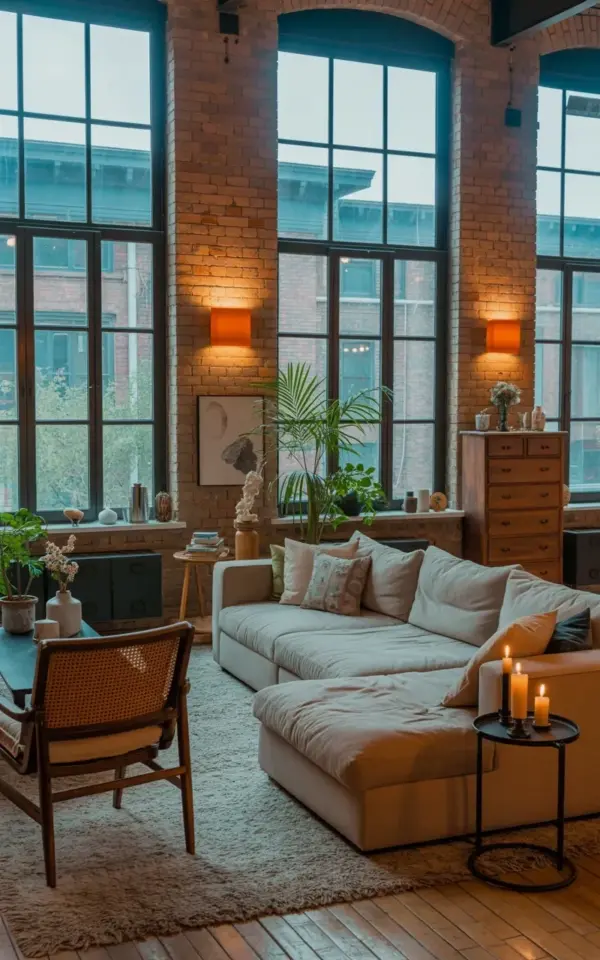
I’ve lost count of how many loft living rooms I’ve seen that slap up some brick veneer and call it a day. Honestly, that’s the first and maybe biggest mistake people make with this style. An industrial loft living room needs more than just a raw wall to feel finished. The brick is the backbone, sure, but without soft, warm textures it ends up cold. Like a warehouse that forgot people live there. The photo here gets it right: that L-shaped beige sectional is what stops the space from feeling like a workshop. The brick stays tough, the sofa makes it livable.
So don’t think you’re done once you have exposed brick. You’re not. The real work is in what you put in front of it.
Picking a Beige Sofa That Actually Works (Not All Does)
Ok so here’s a thing nobody tells you: beige can look dingy in a loft with brick. The reds and browns of the brick can pull the wrong undertones out of a light sofa. Suddenly your nice cream sectional looks like old oatmeal. Not ideal. In the photo I’m referencing, the sectional is a warm, almost mushroom beige. It’s not pure white, not yellowy. That’s the sweet spot.
Look for beige with a slight gray or greige undertone. It plays nice with the orange wall sconces and the warmth of hardwood. Avoid anything too pink or too yellow unless you want a 1970s basement vibe. And please, for the love of floor plans, do not buy a dark charcoal sofa for a brick loft. It makes the room feel like a cave. I’ve been in those spaces and they suck the energy right out of you.
Warm Lighting Mistakes That Kill the Industrial Vibe
The orange wall sconces in that picture? They’re doing heavy lifting. But here’s the common screw-up: people use cool white LED bulbs in industrial fixtures. Why? Because they bought the fixture for the look but didn’t think about the actual light coming out. Result is a harsh, blue-ish glare that fights every warm brick tone in the room. Not gonna lie, it makes me twitch.
Instead, go for bulbs with a color temperature around 2200K to 2700K. That’s a soft amber glow. And use multiple light sources at different heights. A single overhead pendant in a loft is a recipe for shadows and sadness. Sconces like these, a floor lamp near the cane chair, maybe a small table lamp on a sideboard. Layer the light. The orange shade here is genius because it tints the light even warmer. You can cheat by using warm-toned shades even on white bulbs.
Scale and Furniture Placement in Open Loft Rooms
Lofts are big. That’s the point. But a common mistake is scaling up furniture to match the size of the room. Then you end up with a giant sectional that eats the whole floor, and a tiny accent chair that looks lost. The cane-backed chair in the corner of the photo is a good example of proportion. It’s not a huge piece, but it’s placed deliberately in the corner so it anchors that zone without blocking flow. And the L-shaped sectional isn’t a monster size either. It’s generous but leaves breathing room.
Here’s a rule I swear by: leave at least 18 inches between the sofa and any rug edge, and 24 to 36 inches between the front of the sofa and the coffee table. Lofts need walkways. If you can’t skateboard from one end to the other, you might have too much furniture. (Not that I skateboard indoors, but you get the idea.) The tall palm also helps define the corner without taking up floor space. Vertical elements are your friend in an open plan.
The Plant Problem: Not All Greenery Belongs in a Loft
Let me tell you about a mistake I made personally. I put a tiny succulent on a metal shelf in my own loft. Looked like an afterthought. Disappeared against the brick. The photo here uses a tall palm and several potted plants at different heights. That works because the scale matches the room. Tiny plants get swallowed in a warehouse-style space. Go big or go home, honestly.
- Use floor plants like fiddle-leaf fig, palm, or monstera. Tall and leafy.
- Hang some trailing plants from a high shelf or ceiling hook. Adds softness to hard brick.
- Avoid cacti unless you want a desert feel. Lofts are already dry, don’t double down on that.
- Match pot color to your palette: matte terra-cotta, cream ceramic, or black metal. No glossy bright colors.
Another thing: plants need light. Lofts often have floor-to-ceiling windows (like this one). That’s great. But if your only window is small, pick low-light plants. Don’t put a palm in a dark corner and wonder why it dies. Also, that cane-backed chair next to the palm? The textures sing together. Woven cane, soft rug, smooth brick. That’s the kind of mix that feels intentional.
Rug and Flooring: The Silent Style Killers
The light hardwood floor in the photo is a perfect base. It’s pale enough to bounce light around. But I see people put dark walnut floors in lofts and then wonder why the room feels heavy. If you can choose, go for wide planks in a light or medium oak tone. And don’t skimp on the rug. A too-small rug in a loft makes the furniture look like it’s floating on a little island. The cream area rug here is huge and plush. It defines the seating area without boxing it in.
Mistake number one: using a dark, patterned rug. It clashes with the brick pattern. Stick to solid neutrals or very subtle texture (like a shag or a flatweave in a warm cream). The rug should feel like a soft cloud underfoot, not a statement piece. Let the brick be the statement.
Accessories That Don’t Try Too Hard
I have a mild pet peeve about people throwing “industrial” accessories everywhere. Gears, factory signs, exposed bulbs hung from chains. It becomes a theme park version of the style. The living room in the photo keeps it subtle. A few throw pillows on the beige sofa (probably in rust, cream, and maybe a textured knit), the orange sconces, the cane chair, the plants. That’s enough. You don’t need a vintage wheelbarrow as a coffee table.
Instead, bring in softness: a chunky knit throw, a ceramic vase with dried eucalyptus, a stack of books on the floor. The warmth comes from contrast, not from adding more steel and Edison bulbs. Honestly, the best industrial lofts feel more like a cozy art gallery than a machine shop. So edit ruthlessly. If an accessory doesn’t add texture or warmth, it’s probably just taking up space. That tall palm in the corner does more for the room than any rusty sign ever could.
And that’s the trick, really. Industrial loft living room design is about balancing the hard and the soft. The brick is the canvas. The beige sofa, the orange glow, the natural plants, the woven chair. They’re the paint. Get the mix right, and you’ll have a space that feels big and open but also like a place you actually want to curl up in. Start by avoiding the common mistakes I mentioned above, and you’ll save yourself a lot of redecorating down the road.
If you’re planning a loft refresh, try pinning this photo as a reference point. Sometimes seeing it all together helps you spot where your own room might be going wrong. And honestly, I’d love to hear what trick worked best for your space. Let me know in the comments.
#industrialloft #loftlivingroom #livingroomdecor #exposedbrick #interiordesign
Leave a Comment