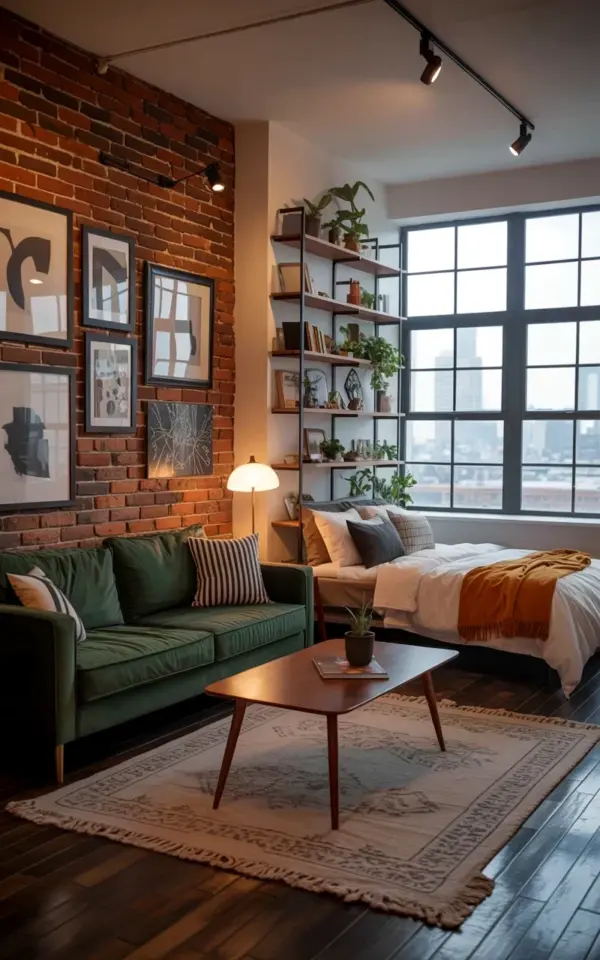
The first time you step into a genuinely styled industrial loft living room, the good ones all have one thing in common: they feel assembled over time, not bought in an afternoon. I have helped three friends nail this exact look, and without fail, the anchor piece is a dark green velvet sofa sitting right against a wall of raw, red exposed brick. That combination is the whole vibe. Everything else in the room just has to hold up its end of the bargain.
You probably have one piece you love already, maybe the sofa or a brick wall, and now you are stuck on the follow-through. This guide is the exact step-by-step process I use to pull the rest of the room together, using the specific layout from the photo that keeps popping up on Pinterest as our reference point. We are talking about the tall black bookshelf, the patterned rug, and the mid-century coffee table. Let’s build this thing in order, starting with the non-negotiable foundation.
## Step 1: Secure the Sofa as Your Dark Green Anchor
The sofa does not just sit in this room, it actively carries the entire color story. Dark green velvet against a red brick wall should feel like a risk, but it works because the tones are so heavily saturated they calm each other down. If your brick is a brighter rust color, lean into a velvet with a slight sheen to bounce some light around.
Do not stress about the sofa being perfect. You need the shape to be deep enough for lounging, but the fabric is the real hero here. Velvet reads instantly as industrial luxury, but if you have pets and a realistic fear of claw marks, a dark green linen or textured cotton twill is a solid, slightly more rugged alternative.
Position the sofa directly against the widest stretch of exposed brick you have. Leave a little breathing room, maybe six inches, so the brick can be seen behind the cushions. In the reference photo, the sofa has these great black and white striped pillows propped against the armrests. When you copy that, mix one large square pillow with two lumbar rectangles, it keeps the eye moving without looking like a display window.
## Step 2: Let the Tall Black Bookshelf Do the Heavy Lifting
Ok so here is the thing about vertical space in a loft: ceilings are usually tall and walls are usually bare. A low media console will get lost immediately. You need a tall black metal bookshelf, the kind with multiple shelves that almost grazes the ceiling, to ground the height of your brick wall.
This shelf does double duty. It holds your stuff, obviously, but more importantly it provides a dark vertical line in the room that matches the black frames on the windows. In the photo, the shelf is styled with a mix of potted plants, stacked books, and random decorative objects. Copy that exact logic. Group your books into clusters of three or five, place a trailing plant near the top, and leave at least one third of the shelf completely empty.
Don’t match the metal finish to anything else. Look, i know design rules say to coordinate finishes, but a matte black bookshelf works because it is the only heavy black furniture piece. It creates a statement without needing a matching set. If you can score one with an open back, use it to split the room visually, which makes a massive difference if you are working with an open-plan space.
## Step 3: Ground the Seating Area with a Patterned Rug
This is where most people freeze. What rug goes under a green sofa and a wooden coffee table? The answer from our reference photo is a beige patterned area rug, and honestly, that neutral choice is the unsung hero of the entire setup.
Here is the thing: your walls are loud and your sofa is dark. The floor needs to be quiet. A beige rug with a subtle diamond or geometric pattern adds texture without introducing a third primary color into the fight. Go for a wool or wool-blend with a low pile if you plan on dragging a coffee table across it regularly.
Make sure the rug is big enough. A common mistake is buying a rug that only fits in front of the sofa, leaving your feet on cold concrete every time you lean back. You want the front feet of the sofa sitting on the rug, with enough space at the front for the coffee table to have its own footing. Measure twice, buy once, and always aim for the rug to extend past the width of the sofa by at least a foot on each side.
## Step 4: Pick a Coffee Table That Creates Contrast
After the brick and the sofa, the coffee table is the third most-touched object in the room. A mid-century modern wooden table with angled legs, like the one in the photo, brings the only significant warmth in the room. That warmth is critical. Without the natural wood tone, the black and green and red would feel like a cave.
Look for a table in a walnut or teak finish to get that rich brown hue that plays nicely with the green. The angled legs are the real detail here, if you go with straight legs, the style shifts closer to traditional woodshop and further away from the retro loft aesthetic. It should feel light and slightly spindly, contrasting the bulky velvet blocks on the sofa.
Use this table to style a couple of heavy objects, not a hundred little ones. A small stack of art books and a chunky ceramic vase will do more for the space than a full tray of coasters and candles. You want to see the wood, so leave some visual breathing room on the surface.
## Step 5: Adjust the Window Treatments and Lighting
Large black-framed windows are a massive feature of the loft look, overlooking a city skyline is a bonus that not all of us have, but the frame style is attainable. Do not cover these windows with curtains. The entire point is to expose the grid of the industrial framing.
If you need privacy, grab some simple roller blinds in a dark shade that disappear when rolled up. For lighting, skip the overhead harshness at dusk and use a floor lamp with an arc or a tall tripod base. The goal is to hit the brick wall with a warm, low wash of light after sunset, which makes the red brick glow and the green velvet shift tone.
Add a small lamp on the bookshelf, too. Lots of lofts have pockets of shadow that a single ceiling light can’t reach. A focused beam on a single plant or a stack of books will make the whole unit feel like a staged vignette. I used a simple clamp brass light on mine, and it honestly changed the whole mood for a couple of bucks.
## Step 6: Style the Shelves with Intention
Your bookshelf is empty right now, so let’s work through this. You need to mix heights and materials, but you also need to avoid creating a perfectly even retail display. I am a fan of the “messy but deliberate” approach.
Here is a quick list of things to gather for the shelving:
– Three or four hardcover books with neutral spines, read or unread, it doesn’t matter.
– A pair of identical ceramic vases, positioned on different levels.
– One tall, leafy plant like a fiddle leaf fig or a snake plant.
– A single framed black and white photo or print.
– One small, odd object that means something, like a brass compass or a souvenir from a trip.
Just remember that the color palette stays muted. You can see in the photo how the plants add the green connection to the sofa and the black frame ties back to the windows. Stick to monochrome decor accents with just the one pop of plant life.
Once you have placed these items, back away and squint. If your eye jumps immediately to one single spot, redistribute the weight. You want the eye to travel up and down the shelf in a zigzag, not land on one interesting center point and stop.
## Final Touches for a Cohesive Industrial Look
If the room feels flat at this point, it’s usually because you’re missing the in-between textures. The bricks are heavyset, the sofa is heavy, and the metal shelf is solid. You need something that feels physically light. A canvas or linen throw blanket draped over one arm of the sofa works magic. Use a black and white pattern to keep it in the same gray-scale family as the accent pillows.
Check your traffic flow, too. In a loft, people tend to walk straight from the kitchen into the living area. If the angled legs of your coffee table are pointing into a walking path, rotate the rug and the table slightly. You want the layout to feel like it encourages sitting down, not like a corridor.
In the middle of your styling session, stop worrying about matching everything exactly. This look has a lot of toughness to it, so a small scratch on the wood table or a slightly wrinkled cushion cover just adds to the story. It is the opposite of a pristine showroom. The best industrial lofts are the ones that feel like they have survived a few Sunday mornings with coffee and a stack of newspapers.
## Start With One Piece and Build the Rest Around It
The great thing about this style is that you do not have to buy everything at once. Start with the dark green sofa or the metal shelf, live with it for a week, and then add the next piece. The brick wall will do most of the talking for you, so just listen to it and let the green perform its magic.
When you get that first corner looking right, take a photo of it at sunset. That will give you the perspective you need to adjust the small stuff. If you want to see this exact setup for reference, scroll back to that Pinterest save and you will know exactly which one we’re talking about. Good luck with the loft, go make it yours.
Leave a Comment