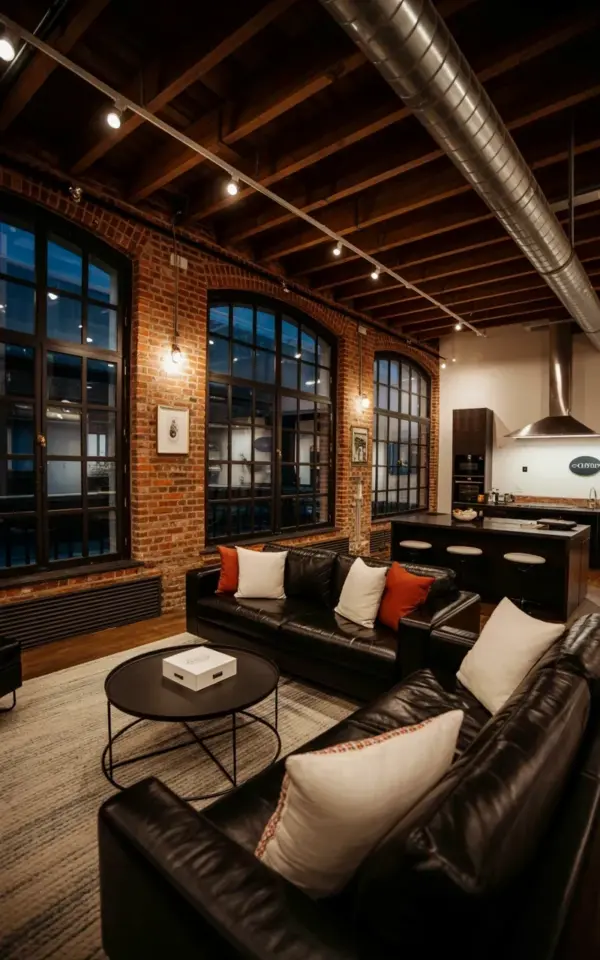
Ok so you found that photo of the industrial loft living room with the arched windows and the black leather sectional, and now you’re wondering how to pull that off without turning your place into a cold warehouse. Good news. You don’t need a multi-million dollar penthouse to steal the best parts of this look. You just need to know what actually matters and what you can fake until it works. I’ve stared at this exact style for years, and I have some honest opinions about what works, what flops, and what you can grab on a budget. Here’s the real deal on nailing industrial loft living room decor without losing your security deposit.
I’m going to break this down like a curated ideas roundup, because honestly, that’s how you should shop for this style anyway. You don’t buy a “look.” You buy individual pieces that happen to live well together. So think of each section below as a different category of inspiration, pulled right from that gorgeous room with the factory vibes.
## The Brick Wall Doesn’t Have to Be Real
Your biggest advantage here is that exposed brick does so much heavy lifting, and it doesn’t have to be authentic masonry. If you’re lucky enough to have the real thing, you’re already halfway there. But if you’re staring at plain drywall, don’t panic. Brick veneer panels are thin, paintable, and you can mount them over almost anything. I’ve seen people use them on one single accent wall and completely transform the entire energy of their rental living room.
The red tones in the photo are warm and earthy, which matters because the rest of the room is pretty stark. That brick gives the space a sense of age and history, a reminder that a factory once hummed right where you’re sitting. If you go with a real brick look, let it stay rough, don’t try to smooth it out perfectly. The charm is in the imperfections, the chipped edges, the mortar lines that aren’t perfectly straight.
Keep the rest of the room neutral if your brick is dark, or go slightly moody if your brick is light red like in the photo.
## Arched Windows Are the Soul of the Loft
Look, not every apartment has the luxury of factory windows, but the way you frame your natural light matters almost as much. The arched black frames in that photo do something interesting. They draw your eye upward and they soften all the hard industrial edges around them. Black window frames are a serious thing, but if you can’t swap your windows out, you can absolutely fake the vibe with black trim or even tall black-framed mirrors with arched tops.
Place one giant arched mirror across from your actual window and suddenly you’ve doubled the light and the sense of space. It’s a trick that interior designers use constantly, and it seriously works. Just make sure your mirror frame is thin and matte black, not shiny and ornate. We’re going for factory chic, not antique mall. A thick frame breaks the illusion completely and makes the whole space feel weighed down.
## Lean Into the Overhead Drama
Here’s the thing about a loft ceiling, it’s a wasted opportunity if it’s completely bare. The wood beams and the metal ductwork in that photo aren’t just structural, they’re part of the décor. They tell the story of what happened in that building before it was a stylish living room. The track lighting serves a purpose, but it also gets to act like sculpture up there, doing its own thing.
If you have high ceilings but no beams, you can install lightweight faux beams that are hollow and easy to mount. They make a huge difference in how the room feels. You want that heavy, grounded feeling overhead, almost like the building is holding you in place. If your ceiling is regular height, don’t try this. Skip the beams and instead invest in a low-profile black track light that hugs the ceiling and points warm light down onto your sofa. You want a suggestion of the industrial, not a full fake ceiling setup that looks like a theater prop.
## The Sofa Has to Do the Heavy Lifting
You can change everything else in the room later, but your main seating choice is the anchor, so don’t rush it. A black leather sectional like the one in the photo is a bold choice, but it works because it’s substantial. It’s not dainty, it’s not trying to be delicate, it’s a solid block of seating that holds its own next to all that brick and wood. Leather also gets better with age, and honestly, a scratched-up leather sofa in an industrial space just looks like it has history.
I’m specifically a fan of the black leather because it disappears into the shadows during the day and becomes a solid anchor at night. If you’re not ready to commit to a full black sectional, get a black leather sofa and add one statement armchair in a deep charcoal or rust tone. The key here is to not buy furniture that feels delicate. Look for thick cushions, low, chunky arms, and a frame that doesn’t wobble when you sit down. The white and red throw pillows in the photo add just enough contrast to keep the whole thing from blending into a black hole of leather.
## Round Metal Coffee Tables Break the Monotony
Notice how the coffee table in the photo is round, not rectangular. That’s a deliberate choice, and you should absolutely steal it. All those strong vertical lines from the windows, the brick, and the beams create a lot of activity. A round metal table softens that visual noise without getting fussy. The circle feels human, welcoming, and gives you a place to rest your drink without cutting the room off from the sofa.
The black metal finish on the table ties directly to the window frames, so there’s a nice visual rhyme happening here. If you find a round table that has a little bit of storage underneath, even better. We all have remotes and magazines and honestly, just junk that needs a place to live. The white box on top of the table in the photo is a great styling trick. It’s simple, closed storage that adds height and a clean line to the flat surface. A stack of books can work too, just don’t pile them so high that you’re afraid to look at them.
## Gray Rugs Make the Whole Thing Cozy
One thing that could easily go wrong in a brick and leather room is that it turns into a cold, echo-y cavern. The gray textured rug in the photo is what stops that from happening. Its job is to pull all the warm and cool tones together, giving your feet a soft place to land and visually breaking up the hard floor. Pick a rug that’s big enough for at least the front feet of your sofa to sit on, don’t get one of those tiny island rugs that floats in the middle of the room.
Gray is the perfect choice because it’s not too warm and not too cool, and it just sits there doing its job. In this room, the rug picks up the gray tones in the brick and the lighter parts of the furniture, making everything feel considered. If you go with a textured rug, and I think you should, you’re adding an extra layer of softness that touches your bare feet and instantly makes the whole place feel more lived-in. A flat, fragile rug will just get destroyed in a high-traffic loft, so get something with a low, dense pile that can handle some life.
## Final Thoughts on Making the Space Yours
Anyone can put a black sofa in a brick room, but making it feel intentional is the real art. If you take anything away from this, let it be this: buy pieces that have a reason to be there, let them share the same visual language like metal, leather, and warm texture, and don’t be afraid to let the room feel a little rugged. That’s the secret. A space like this isn’t meant to be perfect, it’s meant to feel like it was assembled over time with purpose, not from a single catalog page.
If you want to save this idea for later, or if you know someone who’s been obsessing over that arched window look as much as you have, go ahead and pin this somewhere you’ll actually find it. And if you’ve already tried a bold industrial element in your own space, I’d honestly love to hear what worked for you. Those are the best ideas, the ones you learn by trial and error in your actual living room.
Leave a Comment