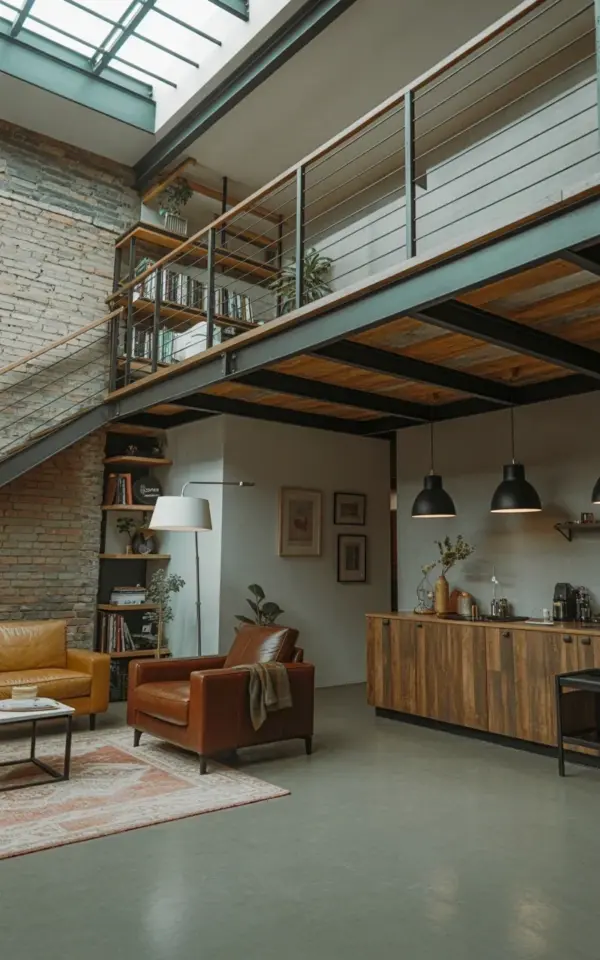
There’s a certain smell to old factory buildings, a mix of cold concrete, dusty brick, and the ghost of whatever was made there a hundred years ago. My own loft doesn’t have that history, not even close, but I did manage to fake a decent version of it on a budget that would make a property developer wince. Let’s talk about industrialdecor that doesn’t cost a fortune. The photo that inspired this post has everything: a mezzanine with black railings, a worn leather armchair, a red vintage rug, and wood cabinets that somehow balance all that rough metal. The good news? You can steal every single one of those ideas without renovating a whole warehouse. Actually, you can do it in a regular apartment. Let me show you how.
How to Get the Factory Loft Look Without the Factory Price
First, you need to understand something. The factory loft aesthetic isn’t about buying expensive “industrial” furniture from a showroom. It’s about collecting pieces that look like they’ve lived a life, then letting the architecture do the heavy lifting. High ceilings are great, but if you don’t have them, you can fake the sense of space with tall curtains hung close to the ceiling and a few vertical lines. The real trick is to focus on surfaces. Concrete floors, exposed brick, and steel railings create the skeleton. Everything else is just furniture you could find at a flea market or a thrift store.
I spent a year hunting for my leather armchair. Not because it was costly, it wasn’t, but because I refused to pay retail for a brand-new one that smelled like a chemical factory instead of a worn saddle. Look for secondhand leather with cracks and patina. That worn look is the entire point. And if you can’t find a real leather piece, textured faux leather in a dark brown will do just fine. Nobody is going to inspect the grain when the lighting is moody and there’s a good rug pulling the room together.
Exposed Brick: Real, Faux, or Paintable Wallpaper
Real exposed brick is the holy grail, obviously. But here’s the thing: most rental apartments and budget homeowners don’t have it. You can still get the look with brick veneer panels, which are basically thin slices of real brick mounted on a backing. They cost less than you’d think, and they’re light enough to install on a single wall in a weekend. Or there’s paintable brick wallpaper, which sounds like a cheap gimmick but honestly fools most people once it’s up and painted in a matte finish. I used it in my old hallway, and my uncle touched the wall to “check” if it was real. He was surprised.
If you’re lucky enough to have actual brick, resist the urge to paint it white. A lot of modern loft photos show whitewashed brick, but that look is going to date fast. Keep the original red or brown tones, just clean it and seal it. The red vintage rug in the photo works so well because it echoes the warm tones in the brick. That’s not an accident. The whole palette hangs together through those earthy reds and browns.
Mezzanine Ideas for Smaller Budgets
A mezzanine level with black metal railings is the defining feature of a factory loft. Adding a real structural mezzanine is a major construction project, no way around it. But if you’re working with a high ceiling, you can create a sleeping loft or a study nook using a freestanding mezzanine kit. These kits are sold by several companies and they’re basically prefabricated steel platforms that bolt together. They’re not cheap, but they’re a fraction of the cost of custom steelwork. I bolted mine together over a long weekend with a friend, lots of swearing, and a massive wrench.
The railing is where you can really save. Black metal railings are just square steel tubes or pipes. A local metal fabricator can weld a simple railing for less than you’d think, or you can use black iron pipe fittings from a hardware store to create an industrial railing that looks surprisingly authentic. The wooden staircase in the photo is key too. It softens all that hard metal, and it’s something you can build with basic lumber and brackets. I used pine treads, stained dark, and they turned out beautiful. That contrast between raw steel and warm wood is the whole game.
Leather Furniture That Gets Better With Age
The brown leather armchair and matching ottoman in that photo aren’t just seating. They’re the warm heart of the entire space. Leather flips the script on the cold, hard surfaces around it. A concrete floor stays cold no matter what, but a leather chair draws you in. I have a theory about leather furniture: it asks you to slow down. It creaks a little when you sit. It holds the shapes of your body over time. That’s the kind of character you cannot buy in a glossy catalog. My own armchair was an online marketplace find, and it smelled like old books and tobacco when it arrived. I was honestly worried about the smell, but a few weeks of airing it out and a leather conditioner fixed it right up.
If you’re on a budget, don’t overlook “scratch and dent” sections of furniture stores. A leather chair with a tiny tear on the back, where nobody can see it, can be seventy percent off. You can patch it if you care, or you can just leave it and call it “character.” That’s the industrial loft way, honestly. Imperfections are part of the design.
Rug and Lighting Choices That Warm Up Concrete
A polished concrete floor is a beautiful thing, but it feels like a skating rink, acoustically and physically. That’s where the vintage rug comes in. The red and beige tones in that photo do serious work. They anchor the seating area and make the whole place feel livable. You don’t need an actual antique rug either. There are plenty of new rugs designed to look like faded vintage Persian rugs, and they’re not expensive. Look for low pile, because a thick shag rug looks weird with industrial steel. You want something with a flat weave and a worn pattern.
Lighting is the other half of the cozy equation. Those black pendant lights hanging over the kitchen island aren’t just functional; they’re the jewelry of the room. I bought mine from a surplus store for a fraction of the designer price. They’re basically metal shades with an Edison bulb. The floor lamp with a white shade is also a smart choice because it spreads soft light upward, which fills the tall space. Honestly, you can’t have too many warm light sources in a factory style room. Overhead lights alone will make it feel like a parking garage. Use lamps, pendants, and maybe a couple of wall sconces to create pools of light at different heights.
Wood Cabinets as the Perfect Industrial Counterbalance
Now let’s talk about the kitchen, because that’s where a lot of industrial loft designs crash and burn. It’s tempting to go full metal and concrete, stainless steel and dark stone, and end up with a space that feels like a morgue. The photo solves this with wood cabinets, and it’s brilliant. Those rustic wooden cabinets with a natural finish bring a warmth that softens the black metal and the rough brick. They also introduce a clean, vertical line that breaks up the horizontal chaos of the open floor plan.
If you have basic builder-grade cabinets, you can give them a rustic industrial makeover with a dark walnut stain or a matte wax. Or you can build simple open shelving out of solid wood planks and black iron pipe brackets. That’s an inexpensive weekend project, and it looks like it came from a Brooklyn loft. The key detail is to keep the wood finish slightly rough. Don’t use glossy polyurethane. Go with an oil finish that highlights the grain and leaves a satin sheen. I used a mix of boiled linseed oil and beeswax on my shelves, and every time I walk past them, I think they look better than when I first made them.
Putting It All Together in a Rental or Renovation
Here’s the real-world advice for pulling this off without a million dollars. Start with the walls and floor. If you have plain white walls, add brick veneer as an accent. If you have carpet, that’s a challenge, but you can lay a large concrete-look vinyl sheet over it or just embrace a neutral neutral carpet and pile on the rugs. Then add the mezzanine or a tall shelving unit that mimics the vertical line of one. After that, it’s about the furniture and the lighting. Buy cheap where it makes sense, like the lamp shades and the rug, but spend a little more on the leather chair and the wood cabinets.
– Use black iron pipe for railings, shelves, and even curtain rods.
– Mix metal and wood in equal measure, so the space doesn’t tip into cold or rustic.
– Add at least three sources of warm light at different heights.
– Buy used leather furniture and restore it with conditioner.
– Don’t be afraid of imperfections, they’re the whole point.
What I love about this style is that it rewards patience. You don’t have to buy everything at once. A room like this grows over time, like an old factory wall collecting grime and stories. Start with one corner, the leather chair and the rug, and build outward. Before you know it, you’ll have a cozy factory loft of your own, without the factory price tag and without the endless renovation chaos. So save this post for your future project, and go check that thrift store for a leather armchair. It might just be waiting for you.
Leave a Comment