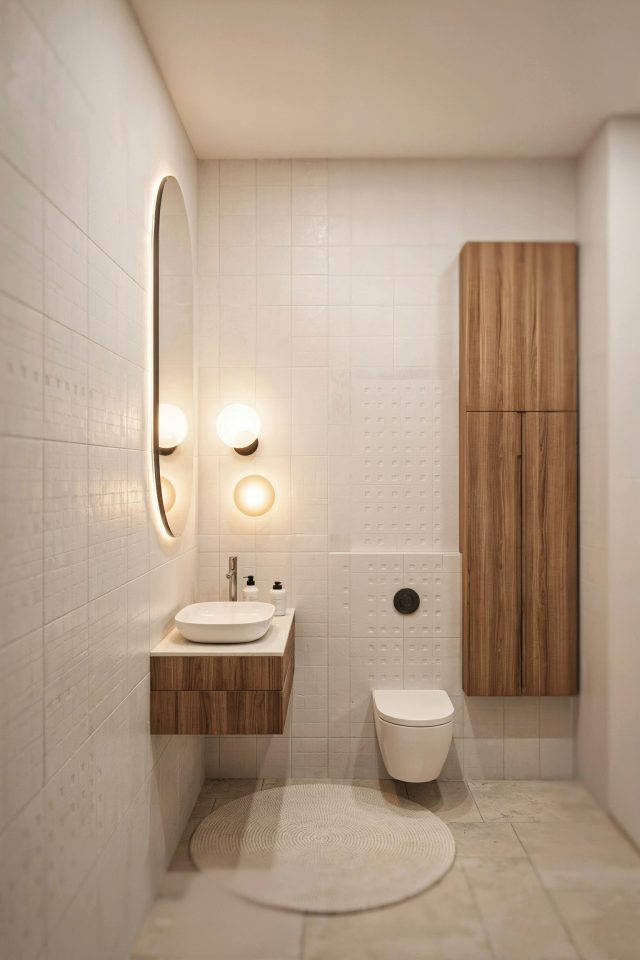
Mistake 1: Ignoring Scale in a Tiny Space
When you first start looking at Japandi small half bathroom decor, it is easy to grab the smallest sink or the narrowest shelf you can find. But that often backfires. A pedestal sink that looks delicate in a showroom can feel lost and flimsy in an actual tiny room. The mistake is thinking smaller equals better.
Instead, focus on proportion. A compact wall-mounted vanity with clean lines gives you storage without eating floor space. A floating shelf that spans the entire width of the wall above the toilet creates a grounded look. Avoid tiny decor pieces that get lost. One larger wooden tray or a single ceramic vase anchors the space. Test scale by holding items against the wall before buying. If it looks too small in the store, it will look smaller at home.
Another common blunder is choosing a mirror that is too small. A round mirror that barely fits above the sink makes the room feel cramped. Go for a mirror that fills at least two-thirds of the width of the vanity. That simple swap opens up the room visually.
Mistake 2: Overloading on Dark Colors
Japandi style loves matte black fixtures and deep wood tones, but a small half bathroom can feel like a cave if you go too dark everywhere. I see people paint all four walls charcoal and then add a black vanity. The result is a depressing closet, not a serene zen space. The fix is balance.
Use dark colors as accents. Matte black faucet, black-framed mirror, or a black toilet paper holder are enough. Keep the walls a soft warm white, light beige, or pale clay. The contrast between light walls and dark fixtures gives that crisp Japandi look without swallowing the light. If you love a darker wall, limit it to one feature wall behind the vanity. Leave the other walls light.
- Choose wall paint with a warm undertone (greige or ivory), not cool gray.
- Use matte black only on metal elements and small accessories.
- Add a single piece of dark wood, like a simple stool or shelf, to tie it together.
Warm wood tones are your friend here. A light oak floating shelf or a bamboo mat on the floor adds natural color without overwhelming the room. The goal is a calm contrast, not a dark box.
Mistake 3: Skimping on Storage
Half bathrooms are often the most neglected storage zone in a house. People think a small room does not need cabinets because nobody stores towels there. Then they end up with toilet paper rolling around the floor and a cluttered countertop. That kills the minimalist vibe fast.
You do not need a massive cabinet. A simple wall-mounted vanity with one drawer and a lower shelf works wonders. Use that drawer for spare toilet paper, small cleaning supplies, and a plunger. The shelf can hold a basket with extra hand towels or a few rolled washcloths. A narrow tower cabinet between the toilet and wall is another space-saver. It keeps everything hidden while maintaining clean lines.
Floating shelves above the toilet are classic Japandi, but do not overload them. One shelf with a small plant and a jar of cotton balls is plenty. Too many shelves turn the room into a display case. Stick to one or two, and keep them sparse. That way you have storage without visual clutter.
Mistake 4: Choosing the Wrong Vanity
Many people pick a vanity that is either too bulky or too shallow. A deep cabinet vanity juts into the walkway, making the room feel tight. A tiny sink with no counter space forces you to put hand soap on the toilet tank. Neither feels intentional or serene.
For a Japandi look, go for a floating vanity with clean, straight lines. Avoid ornate handles or curved edges. A rectangle or square shape in light wood or matte white works best. The sink should be an under-mount or vessel style in a simple oval or rectangle. Vessel sinks can add a sculptural element, but they take up counter space. If your half bath is under five feet wide, stick to an under-mount sink.
Check the depth. A vanity that is 18 inches deep can still leave enough walking room if the toilet is opposite. Measure your clearances before buying. A common trick is to use a wall-mounted sink without a cabinet underneath. A simple shelf below the sink gives storage while keeping the floor open. That is pure Japandi: nothing touches the ground except the toilet.
Mistake 5: Forgetting About Lighting
Half bathrooms often get the worst lighting in the house. A single overhead fixture casts shadows on your face and makes the space feel harsh. That is the opposite of zen. The mistake is ignoring lighting as a design element.
Layer your light. Start with a dimmable overhead light on a warm white bulb (2700K to 3000K). Then add a sconce on each side of the mirror, or one above if the mirror is small. Side sconces at eye level soften shadows. If you cannot wire new lights, use a plug-in sconce with a cord that blends into the wall. A small LED strip under the floating shelf can provide ambient glow at night.
Choose fixtures in matte black or brushed brass for that Japandi touch. Avoid shiny chrome or elaborate designs. Simple round or cylindrical shapes work best. The light should be warm enough to make wood tones glow. Cool blue light ruins the whole calm mood.
Mistake 6: Using Too Many Accessories
This is the biggest sin in minimalist design. People buy a cute bamboo soap dispenser, a ceramic toothbrush holder, a small plant, a framed print, and a decorative tray. Suddenly the counter looks like a gift shop. The room loses its quietness. Japandi is about restraint.
Stick to three items maximum on the countertop. A soap dispenser, a small plant or single stem in a vase, and a hand towel folded neatly. That is it. No lotion bottles, no extra jars, no signs. Keep the walls bare except for the mirror and maybe one small piece of art if it is very simple. A single black and white line drawing can work, but skip framed quotes or busy patterns.
Use a tray only if you need to group things like a candle and matches. Otherwise, leave it out. Every item should earn its place by being functional or deeply calming. If you are not sure, remove half of what you put out. The empty space itself becomes the decoration.
Mistake 7: Neglecting Texture and Warmth
Japandi can feel cold and sterile if you only use hard surfaces like tile, glass, and metal. That is the biggest mistake in small half bathroom decor. People forget the softness. A room with all glossy tiles and a glass shelf feels like a doctor’s office, not a zen retreat.
Introduce natural texture. A woven bamboo wastebasket, a cotton or linen hand towel, a small rug made of jute or wool. The rug grounds the space and adds warmth underfoot. Choose a rug that is small enough to sit in front of the sink without getting in the way of the door. A wooden toilet seat instead of white plastic changes the whole feel. Even a simple wooden stool next to the toilet adds a natural element.
Texture also comes from the wall finish. Consider a matte paint instead of semi-gloss. A shiplap accent wall in a warm white gives subtle lines without being busy. A single strip of warm wood slats behind the vanity creates a focal point. Keep all textures in the same warm family. Mix rough and smooth, but stay consistent in tone. That layered feeling makes the space look complete and lived in, not staged.
Final Thoughts on Your Serene Space
Working with a small half bathroom is a chance to practice restraint, not a limitation. Avoid these seven mistakes and you will end up with a room that feels bigger, calmer, and more intentional. Start with the right vanity and lighting, then add only what you truly need. Let the empty space breathe. That is the heart of Japandi design.
If you found this helpful, save this pin for your next renovation or share it with someone who is planning a bathroom makeover. Small changes make a big difference when you know what to avoid.
#japandibathroom #halfbathideas #minimalistbathroom #smallbathroomdecor #zendesign
Leave a Comment